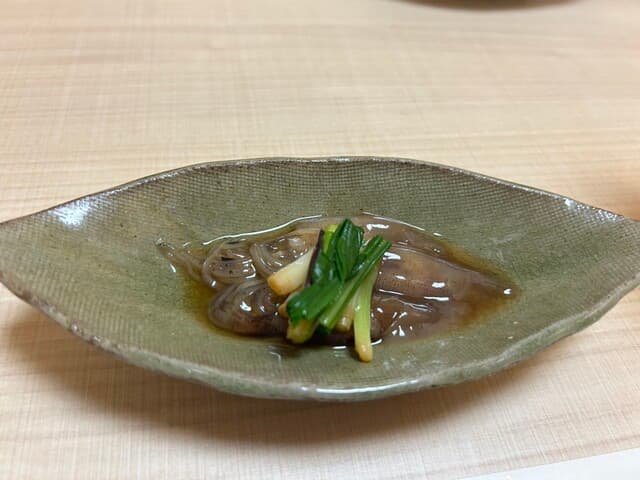
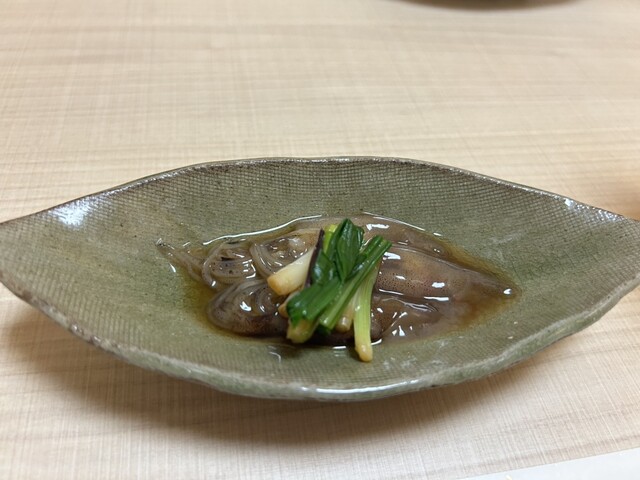
蛍烏賊は富山の春の風物詩として有名ですが、冷凍冷蔵技術がまだ発達していなかった時代には、地元で消費されきれない分は松の木の肥料として使われていました。そのため、地元では「松烏賊」と呼ばれていたそうです。
Nowadays, by rapidly freezing them, it's possible to find raw jellyfish dishes in supermarkets across the capital region. This is a great convenience.
Thanks to this, the chef was able to create oshimpachi—a method of preserving fish that local fishermen could only do by curing it immediately after catching it—with his own unique flavors.
I was able to enjoy such an elaborate dish as the coastal pickled squid at a familiar restaurant.
The composition of the spring menu is,
Appetizer: Seafood pickles from the open-sea area
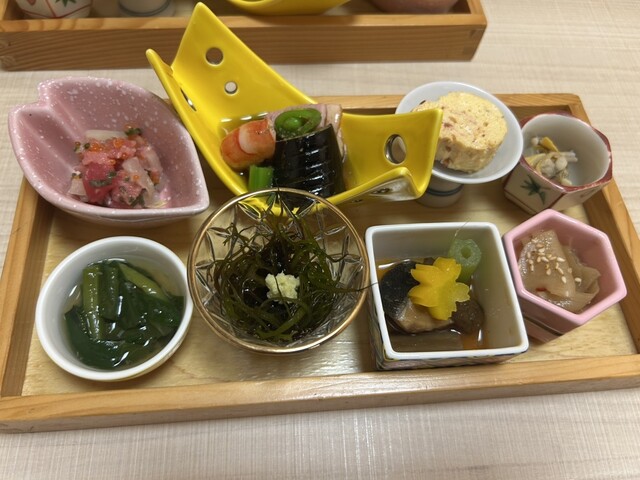
Eight inches: Grilled salmon served with vegetables, pickled radish, egg custard with sake sauce, cod fillet, duck breast, fresh ginger and shiso, boiled scallions with vinegar.
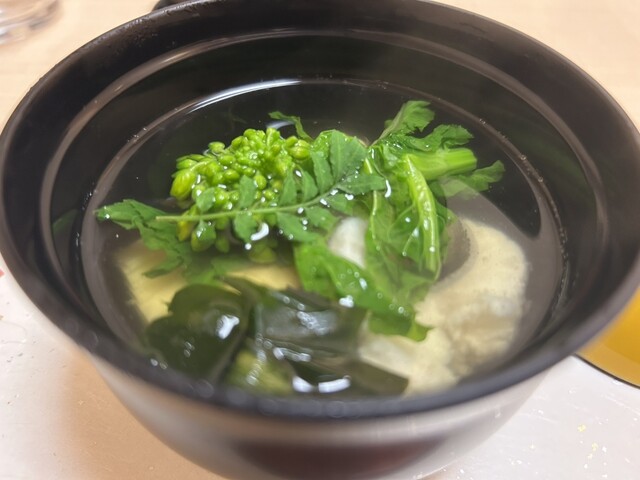
Wash dishes: Ainame's young bamboo bowls
Sashimi: Tessa
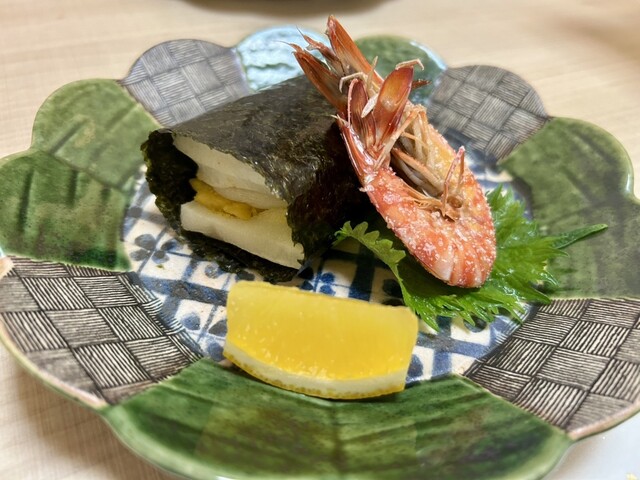
Meats: Salt-baked shrimp and Tangmo cakes
Stew: Stewed beef teriyaki
Supplementary dish: Grilled Saba tuna fillet
Meal: Curry Oden
Sweetness: Matcha Crisp
I was able to enjoy the usual, classic Japanese-style cuisine.
This time, the dining companions seemed to be looking forward to enjoying winter-style pot-livered dishes. Nevertheless, it was reassuring to see that they were fully satisfied with the experience.
I hadn't mentioned the time when I held a New Year's party at my favorite "Kazuumiya" restaurant with my colleagues. So, I'm updating this story.
Starting with oysters, we continued with the usual eight-course menu. Then came the dishes for Zuwai crab soup.
The main dish was the familiar scallop dish.
The cold salmon with a rich layer of fat is delicious when eaten with a quick shabushabu method.
We enjoyed a meal of lotus steam topped with soba, leaving us full.
I was given a warm welcome by the husband and the manager of the restaurant. The members who were taken there for the first time were also very satisfied.
Since my birthday, a drinking friend offered to treat me, so I chose the "Kazuumiya" restaurant in Yushima.
Located at the corner behind the Dora-yaki rabbit, not even 10 minutes from either Yuzima Station or Gotomachi Station.
Upon opening the grand entrance, the owner came out to greet me. I handed over my coat and was led to a fireplace-style table seat.
The side dish is a crab.
In the classic eight-piece set, there are brightly colored dishes for sake and side dishes. I ordered it with hot sake.
As a substitute for bowls, oyster clay pot stew is a great idea, as it offers delicious broth as well.
The main dish is bonito shabushabu.
We enjoy eating salmon that has a rich fat coating, biting it until its color changes slightly, and then wrapping it around the vegetables.
Fried dishes include vegetables and scallops with cheese in between.
The dishes include sweet tuna "Wakashii-yaki" and white fish "Shiobiki-yaki".
〆はキノコ蕎麦
For 8,000 yen per course, the number of dishes and the quality of the food are truly remarkable. Therefore, I booked this place for a New Year's party with my colleagues at work at the beginning of the year. It was a great experience to be treated like a VIP.
Even though it's called "Yumidake," it's actually a Japanese-style restaurant located at an alley near Otomachi.
The exterior looks impressive, making it seem like a high-end restaurant. However, in reality, it’s a place where you can enjoy a set meal and Japanese sake at affordable prices.
Last year at the end, I visited this restaurant for the first time in a long time and ordered the scallop course.
Always amazed by the exquisite eight-ingredient dishes and steaks. The skills used are unchanged.
This time, the fried item is scallop tempura. Despite having a thick texture, it is extremely soft and delicious.
The scallop is served in a clay pot, with vegetables and tofu lightly cooked at the same time. This makes it convenient to start eating right away.
The cold salmon with fat is cooked in boiling broth, allowing the fat to melt and the delicious flavor to spread throughout the mouth.
As a professional restaurant-review translation engine, I will translate the provided text from Japanese to English. Please note that I will only retain the necessary proper nouns and avoid mixing Latin letters with Japanese characters within the same word. The translation should be natural in English, with
Although the number of words is limited, the combination of a skilled chef and a cheerful and enjoyable manager creates an atmosphere that warms not only the body but also the heart.
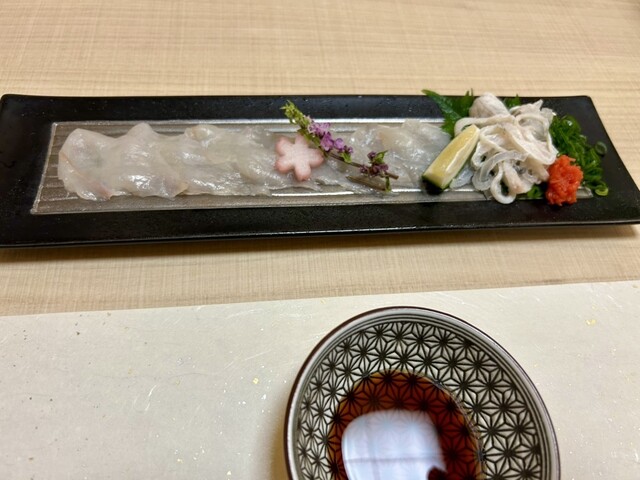
かず味家は、60歳の誕生日にレビュアーの仲間が還暦パーティを開いてくれた思い出の店です。
Last year on my birthday, I also requested to have a scallop course at that memorable place.
Initially, it started with an eight-inch portion.
In an eight-inch plate, there are a total of 11 dishes packed tightly, with no room for anything else between them. Just this alone is enough to make sake get better with each serving.
Among them, the smoked crabs, clams, and oysters are truly delicious.
Next, the sashimi includes grilled tuna, grilled salmon, sea scallops, and a mixed arrangement of whitefish and other seafood.
All dishes have a well-aged umami flavor, making them delicious.
The dish is fried pork belly.
I think that pufferfish is more delicious when cooked over a higher heat compared to when it is served as sashimi.
From beneath the crispy thin crust, a plump and elastic texture emerges, allowing one to enjoy the texture while savoring the flavor.
The main scallop dish was prepared by the owner, who asked, "Can we add the vegetables first? Or do you prefer to handle the timing yourself?" So, I decided to have them prepare the vegetables first.
The vegetables include natural shiitake mushrooms, morels, portobello mushrooms, onions, cabbages, spring chrysanthemums, tofu, and more. The quantity is so substantial that it hardly seems like a "shabushabu" dish.
The main dish consists of a large cold scallop weighing over 8 kilograms, carefully sliced into thin pieces. There are also 15 of these slices. Additionally, there are six large raw oysters and six raw cod roe pieces.
I'm surprised that it's two servings per person.
I ate one piece of salmon as sashimi to experience the richness of its fat. After that, I used shabushabu to remove excess fat, and then served it with ponzu sauce and red leaf miso for a refreshing finish.
The oysters are eaten raw, so we simply grill them briefly over direct heat to bring them to a rare state. Then, we serve them with the ponzu sauce, allowing them to slide smoothly into the mouth.
I had white rice with shabushabu for the first time. Since it was fresh white rice served with white rice ponzu, it was definitely delicious.
I was quite full by the time the noodle dish came out, so I’m completely satisfied now.
I was escorted to the door by my husband and the shop owner, and I was truly treated like a VIP.
I still remember clearly the day I visited this restaurant for the first time.
In the autumn of 2012, I happened to pass by a restaurant with a good atmosphere. I thought it would be a nice place to dine, but its luxurious-looking exterior made me hesitate to just walk past it. So, I stopped to take a look at the menu displayed at the door. The prices for the dishes seemed quite average, so I decided to give it a try and entered the restaurant.
The venue was spacious and comfortable, featuring a drop-down table and counter seats. However, there were few customers present, so it seemed like everything would be fine. The chef, who was quiet and modest, prepared authentic kaiseki cuisine that was delicious.
Moreover, the female manager, dressed in a kimono, has a very friendly and pleasant manner of service. As a result, we organized several off-ice meetings with those who have a strong preference for food quality.
Now it has become a highly popular restaurant, and it's quite difficult to get reservations. However, after a year, we decided to gather our friends again and visit once more.
Currently, only courses are available. I have reserved the most convenient option, a 4,000 yen course.
Even so, with just eight inches of cooking space, there are still 13 dishes available. It’s clear that each dish has been prepared with great care and attention to detail.
Of course, the taste is impeccable, which leads to a stronger appetite for alcohol.
Let's drink New Policy No.6 carefully, even if we get a quart bottle.
The dishes include rare abalone and shrimp shells. Even though they are called "shijimi," these abalones are quite large, and their flesh is red. It turns out to be a different species from ordinary clams.
The sashimi includes grilled bonito, salmon, shrimp, and tuna.
The second wine paired with the sashimi is "Uki Uki" with a pink label.
It has a fruity aroma like apples, and a fresh taste with a crisp acidity. The wine is slightly cloudy, so you can sense a slight carbonation that gives it a pungent flavor.
The stew consists of a combination of young bamboo stew and stewed ganmanjiko along with salmon fillets. Even just the young bamboo stew alone could make it a complete meal, but adding another dish gives you a truly satisfying experience.
The fried items are slices of white fish, wrapped in seaweed cheese and fried until crispy. The oil is drained well, making them delicious.
After serving the stylish ponzu jelly as a finishing touch, along with gratin, and a salad of octopus and vegetables, the meal was completed. The last course was sliced noodles, and thank you very much for the delicious meal.
This time, the conversation among my friends was so lively that I ended up opening several bottles of sake one after another. Nevertheless, the total cost was only about 8,000 yen per person, so the cost-effectiveness remains as good as ever.
かず味家さんは、友人のレビュアーたちが、ほぼ貸切で還暦祝いの宴席を設けてくれた思い出の店です。
When it first opened, this was a restaurant that you could simply go there on the same day without any trouble. However, after it became a restaurant with difficult reservations, it became impossible to visit there casually. But recently, I stopped by the Italian bar in Kuromonchō on my way back from there, and managed to make a reservation in advance.
The menu prices are available in three options: 4,000 yen, 6,000 yen, and 8,000 yen. This time, we choose the 6,000 yen option.
The eight-inch portion is so abundant that it seems to be overflowing from the black-colored serving plate. The colors used are also very vivid.
Sawae crab, duck roe, burdock, winter melon, white and true fish roe of tuna, eggplant-flavored soy sauce with shrimp, finely chopped ingredients of iburi gatta and cream cheese, corn, morel mushroom, ghost lantern, boiled jelly, water chestnut, senmaii, soya bean… There are a total of 15 different dishes. Just these alone should be enough to satisfy two cups of sake. Of course, the taste is also excellent.
The dishes served in the bowl are fresh abalone. They have been carefully boned, so the texture is pleasant to the tongue, and the flavor of the broth is also delicious.
The sashimi includes panaque with shrimp, black mussels, salmon, and white squid.
The freshness is excellent, and the combination of flavors is also great.
The dish served is salt-baked grayling. It was a bit overcooked, but that's understandable. However, if you exclude the skin, it’s still a delicious dish of grayling.
The dishes served are eggplant with lion garlic fried crumbs. The oil is well cut, and the breadcrumb texture is crisp. It’s easy to finish eating all of them.
The stew consists of a Dutch pot roast of eggplant and a stir-fried combination of shrimp.
The compatibility between eggplant and salmon demonstrates the excellent sense of taste of the restaurant owner.
The rock oysters were small in size, so their umami was not very strong. However, it was a dish that resembled the flavors typical of early summer.
This dish is fried udon with cherry shrimp. The udon is made from fine udon produced in Hokkaido, cooled and served cold alongside a cold udon. It perfectly complements the meal after drinking it together.
I ordered a rare sake from Yoshida Zō in Ishikawa Prefecture, called U (Uyū). It was served in a 4-jin bottle.
This is a Japanese restaurant that offers a type of sake that is pure rice, unfiltered, and has a floral flavor reminiscent of wine. It's quite an interesting sake product.
A delicious meal, accompanied by pleasant conversations with the cheerful and natural-sounding female manager, making it a truly healing evening.
The Izumi-dori and Yushima area is known for its quiet and tranquil atmosphere. Initially, this restaurant was a place where you could enter casually even on your first visit. However, due to the influence of "Yumlog," it has become a popular restaurant that is difficult to get reservations for.
It's good that the restaurant is thriving, but it's only the owner and the manager working together. During peak hours, everything is in chaos, with the beautiful lady in traditional Japanese clothes running around frantically. It was quite distressing to see such a situation.
Recently, we stopped offering individual orders and standardized our menu prices at 4,000 yen, 6,000 yen, and 8,000 yen for courses. As a result, the prices have become much more reasonable.
However, during business hours, there may not be time to answer phone calls. Therefore, it is recommended to make reservations early in the morning.
For details about the course dishes, please refer to the photos that have been added.
October 2012
At the corner of the road leading from Ueno Hirokoji to Yushima, a new kaiseki restaurant has opened.
From the exterior, it gave the impression of being a place with a high price tag. However, since there was a menu displayed on the front, I decided to take a look inside. To my surprise, the prices were surprisingly affordable.
This is a very effective method. I broke through the gate and entered, and there was a large stone step where I took off my shoes and sat down in the dining room, creating an authentic atmosphere of a traditional restaurant.
The interior of the restaurant features a counter area and four sofas with fireplace-style tables for 4 people, along with one large table for 8 people. In total, there are around 25 seats available, making it suitable for small groups. The space is spacious and comfortable.
The serving is presented in a bamboo container with six small bowls, allowing one to enjoy different ingredients bit by bit. This is a charming and effective way of capturing the essence of a "ryōbē" (a type of cold drink), where each bite offers a unique flavor.
The menu offers a variety of dishes, starting from as little as 500 yen for light appetizers, up to 2800 yen for matsutake mushrooms and duck shabushabu. The average price is around 1000 yen, making it an affordable option.
First, let's try sashimi as a starting point.
Ueno and Yushima area’s izakayas are great for yakisoba and matsutake-yakisoba, but there aren’t many places where the sashimi is also delicious. So I wasn’t expecting much. However, at Ichiro, they delivered sashimi that was truly impressive, thanks to their excellent knife skills.
I learned that this is a chef who has undergone proper training. It turns out that he works at a teahouse in Nihonbashi, and he just opened his own restaurant in August.
In that case, let’s try the stew-like dish called “Kujin Suji Daikon Nukemaki”. The kujin suji meat, a premium ingredient, is cooked until it becomes soft and creamy. However, the daikon remains intact, maintaining its shape and offering a firm bite. Moreover, the taste is truly impressive.
In that case, I tried to enjoy the Matsutake stew prepared in a earthen pot. The broth was well extracted, and the small matsutake mushrooms were so densely packed that it seemed like a whole mushroom was used—probably more than one. The aroma of matsutake mushrooms tickled my nose.
I thought that even those who have strict taste preferences in terms of food would definitely be satisfied with this dish. Since I was looking for a restaurant to attend an off-site gathering at the time, I decided to make a reservation impulsively.
The details of this event are expected to be shared by other review writers. So, please stay tuned and keep an open mind.
Finally, one thing I would like to point out is that this restaurant has only been open independently for a short time, and the chef prepares the food alone. Therefore, when the restaurant gets crowded, the process of preparing the food becomes slower. This is not a good option for those who are impatient. I recommend it only to people who can spend time chatting with others who share similar interests.