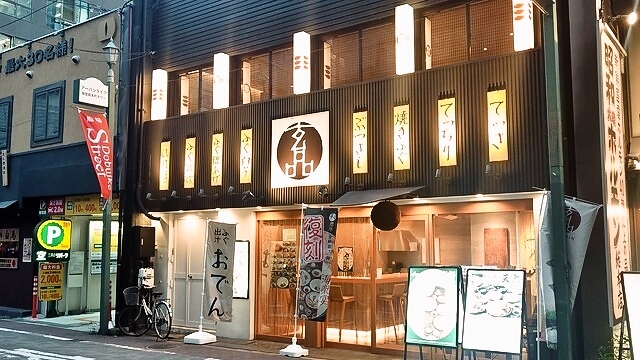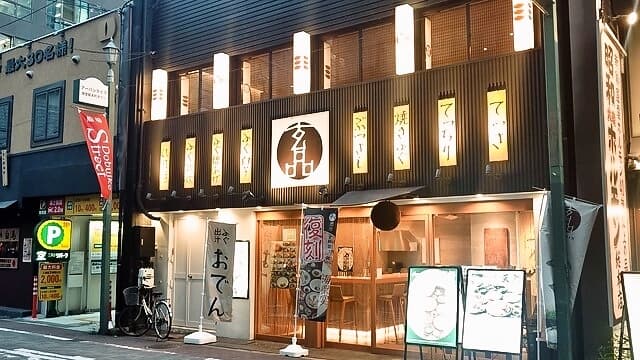
Honestly, oden isn’t a dish that I really like. But since there was mention of oden made with trafugu broth, I decided to give it a try. The restaurant is located on the first floor of Genpōbenchō, right at the entrance, on the left-hand side. As the name suggests, the restaurant has only a counter with seven seats. It seems that there are also seats upstairs for customers from Genpōbenchō.
I thought it would be crowded due to its popularity, so I decided to use the "flying attack" technique as soon as the restaurant opened. However, perhaps I was too eager, and I arrived quite early. After wasting some time, I returned to the front of the store around 16:50. The lights in the store were still on… I had heard that the store would open from 17:00, so I waited for a while longer. A group that seemed to be customers arrived at around 17:00, so I joined them and entered the store. It seems that this is a restaurant with its own unique traditions, as expected. It’s a great place to eat.
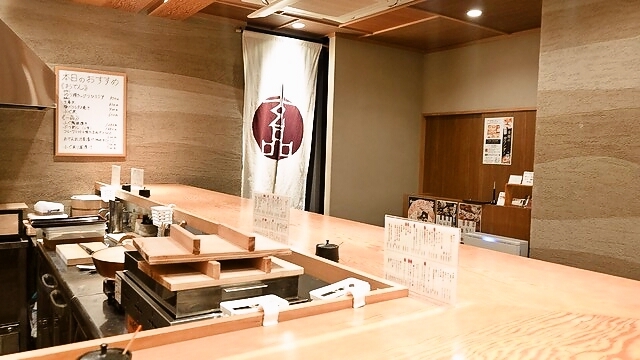
The bathroom is located at the very back of the first floor, so you will have to pass through the first-floor seating area. This place has an old-fashioned Japanese tavern-style decor, while the counter seats are bright and modern in appearance. During my visit, there was only one person at the counters. However, as winter approaches and the fugu season arrives, it is expected that this place will become very popular. Therefore, it might be better to make reservations in advance.
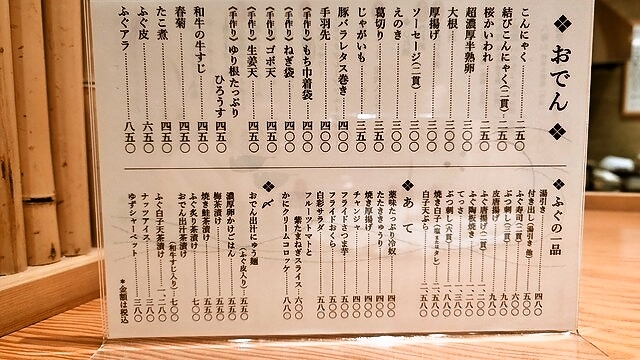
I was seated at a table with a L-shaped counter, where I could see the interior of the counter. It was neatly arranged, and nothing unnecessary was placed there. I expected to be served edamame with eel broth, so I expected to have radish, fried egg, and konnyaku on the menu. However, upon looking at the menu, I saw items like eel skin and eel arashi listed. So, I changed my plan and ordered mainly eel dishes. There was an edamame with eel arashi, but I didn’t eat it this time. When referring to eel arashi, it usually refers to parts like the head, bone-in middle part, or skin-on middle part. These are considered highly valuable parts of the eel. But since it was just edamame, I didn’t order those parts. It’s possible that they used fresh eel instead of the traditional parts to make it sound more appealing. Since I didn’t order anything specific, I can’t really say anything…
Instead of oden, there are individual dishes featuring lobster, such as clay-roasted meat, roasted white eel, lobster tempura, lobster sashimi, and skin. Additionally, there are oden-based dishes like soy sauce noodles or tea pickles, which truly whet the appetite.
This time, what I particularly liked was the skin. I ordered oden and fried skin dishes. Before they were served, I thought the amount of skin offered would be quite small, like a simple soy sauce dressing. But it turned out to be a substantial portion, which makes coming to this restaurant worthwhile. Unfortunately, due to the large amount of skin, I couldn’t enjoy the white fish. That’s the only downside.
Let’s deviate a bit from the topic. In Western Japan, there is a culture of consuming fugu skin as sashimi or in soups. This type of dish is called “te-tchi-ri,” but fugu itself is sometimes referred to as “tetsuban.” This has a unique Shikoku-style meaning: if you’re hit by it, you might die. Therefore, when tetsuban becomes shorter, it’s called te-tchi-ri; and when fugu skin is used, it’s called te-tchi. It seems that fugu is mainly consumed in Shikoku region. People in Western Japan often dislike the chewy texture of fugu skin. That’s why some restaurants in Eastern Japan even remove a part of the inner layer before serving it… The chewy texture of fugu skin is actually beneficial for beauty purposes, and it’s precisely this characteristic that makes fugu so delicious.
On the counter, there is a square-shaped dango pot that is commonly seen in dango shops. “Aka” is a term unique to Kansai region, referring to a copper pot. Even when ordering dango, it isn’t served in that pot. Instead, the ingredients brought from the back kitchen are lightly cooked using a round pot similar to a techtori pot before being served. Upon asking about this, I learned that the ingredients placed in the square-shaped pot include radishes and fried tofu. Since lobster can lose its flavor if overcooked, it is carefully prepared each time a customer orders. This shows the dedication of these traditional restaurants.
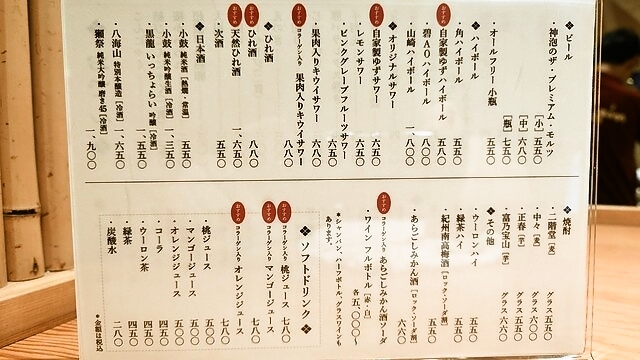
Alcoholic drinks include various types of beer, high-ball drinks, sawhorses, shochu, etc. However, when it comes to potluck dishes, it can be said that there are no other drink options besides Japanese sake. Regarding potluck drinks, there are two options: Potluck Drink (880 yen) and Natural Potluck Drink (1,650 yen). The prices differ significantly. Upon inquiry, it was learned that the ingredients used in Potluck Drink are farmed products, while those used in Natural Potluck Drink are natural products. Natural products tend to have a larger size due to their natural growth environment compared to farmed products. Additionally, because they undergo more movement, they contain a richer balance of fats and umami compounds, resulting in a much more flavorful and rich taste when used as potluck drinks. Normally, I would compare both Potluck Drink and Natural Potluck Drink, but this time, I had the opportunity to enjoy only Natural Potluck Drink.
When I go out to eat fugu, the cost is likely to exceed 10,000 yen. If one person can hardly even enjoy tecuteri, then this price is really a great deal. By being creative in ordering, one can enjoy a full meal that includes tecuteri, sashimi, and even chazuke.