Gran Alegria defeated Mile CS, securing its fifth win in the Mile G1 series. It also completed its remarkable journey with pride.
My horse racing bets have been mainly based on single wins and double wins recently. I found that my horses performed very well with Gran Alegria; they won quite a few single races. On the other hand, when it seemed like this race might be a lose-lose situation, I would bet against the popular horse, and that strategy often paid off.
The final mile CS race saw the "strong 3-year-old generation" champion, Shanelle Mystesser, take the lead. Although the popularity among fans was divided, and when I opened the lid to find that the payout was only 1.7 times the expected amount, it was still a decent single-race win that earned me some small profits.
Even looking back at past generations, this mare is considered one of my favorite horses. I am very excited about her future as a breeding mare and the opportunities she will have to shine.
Actually, Gran Alegeria had a younger brother named Bultoong, who was one year younger than him. However, after winning a decisive victory in a new horse race, his condition deteriorated due to illness, resulting in a poor prognosis and ultimately leading to an execution as a form of安乐死处理。I hope that the bloodline of that brother will be passed down to future generations.
There is a saying that horse racing is a form of blood sport. And that, in itself, is quite fascinating, isn't it? It's difficult to remember even the common proper nouns, but somehow, the names of horse lineages can be remembered clearly, even if they are somewhat complicated. That's really strange.
In terms of hobbies, I have a strong feeling that "Eat Log" might eventually fade away. However, horse racing has been something I've been involved with since my second year in middle school. I believe it will definitely become a lifelong hobby.
On that day, I visited the Racing Museum located in the Koenish Forest Park, which has a deep connection to horse racing. I spent some time there and attended the autumn special exhibition.
There were many exhibits related to Emperor Meiji, and since it coincided with the time of the drama "Aoi Ten no Shōkei," I was able to visit and learn about these exhibits for quite an hour, which was truly interesting.
History is also one of my hobbies. It's great that by reflecting on the past, we can rejuvenate our view of the present era.
After visiting the museum, we went out to Shin-Sugita for a slightly late lunch. We decided to use this toreutuan store that is directly connected to the Keikyu-Sugita Station.
Our restaurant is located on the first floor of the Plala Sugita shopping mall, which is an annex to the Keikyu Sugita Station.
The exact founding year is unclear. However, a news article from 2013 states that the restaurant received a bronze award in the "Real-Flavored Yokohama Street Food No.1 Determination Battle - Gachi Dode - 2013." The article also mentions that the restaurant has been in operation for 38 years. By this calculation, it can be determined that the restaurant was founded in 1975 (Showa 50).
プララ杉田の建設年は1993年(平成5年)です。さらに調査を進めたところ、プララ杉田が建設される前には、近隣の地域で飲食店として営業していたようです。プララ杉田が建設された際には、とんかつ専門店として入居したとされています。
Therefore, since its establishment, it has been 46 years. A half-century has passed in this perspective. As for the history of Tonkatsu Amami as a brand, it has been 28 years this year.
The restaurant was founded during the era of our predecessor. It seems that the origin of the store name comes from his wife (the mother of the current owner), who was born on Amami Ōshima.
This day, we arrived at our restaurant around 12:40.
The interior of the restaurant features three comfortable counter seats, along with five four-person tables totaling 20 seats, for a capacity of 23 seats.
The interior of the restaurant was quite crowded, but there was one empty table and two empty seats at the counter. Following the guidance of the staff, we settled down at the counter seats.
The restaurant is run by a married couple, believed to be the second-generation owners of the business.
On the table, there are menus available. In addition to lunch menus, there are also classic set meals, dlyun menus, and side dishes.
As a classic menu item, the Roasted Chicken Set meal costs @1,430 yen, while the Premium Roasted Chicken Set meal costs @1,705 yen. The Tandoori Chicken Set meal, on the other hand, costs @990 yen. However, for lunch menus, the Tandoori Chicken Set meal is available for @770 yen, and the Tandoori Chicken Lunch meal, which includes sashimi, costs @1,045 yen—a quite affordable price.
I have learned from experience that in restaurants with an atmosphere reminiscent of traditional town-toon-katsu shops, the lunch menus are quite affordable. Therefore, without taking the risk of ordering the "Special Selection Roasted Toon-Katsu," I simply ordered a regular toon-katsu.
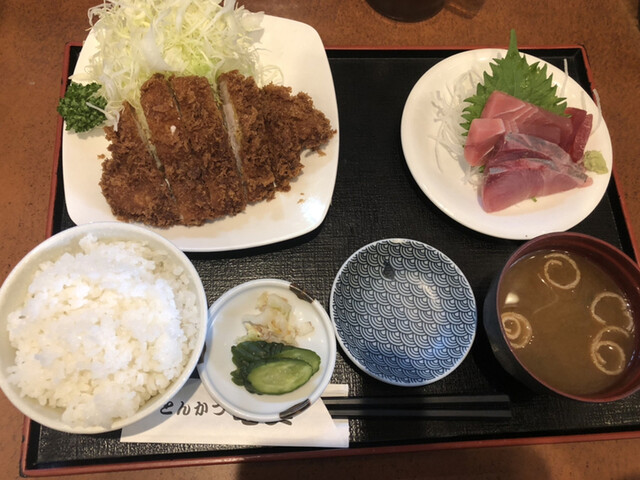
The restaurant was quite crowded, but the service was fairly smooth. After waiting for about 8 minutes, my order for tonkatsu lunch was delivered.
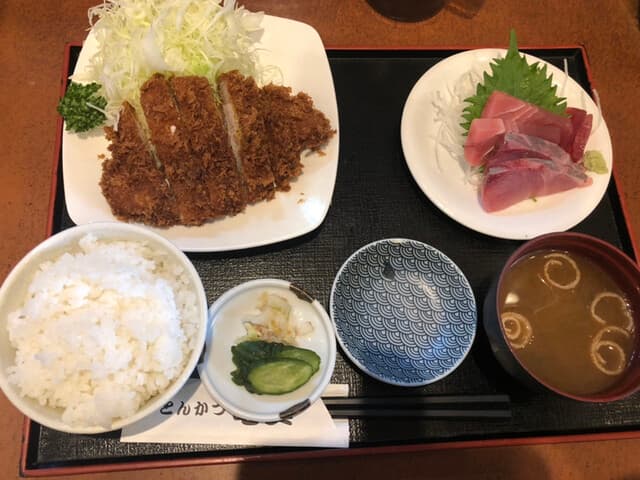
The menu includes small-sized tostas cut into five pieces (about 80g each), sashimi, pickles, miso soup, and rice.
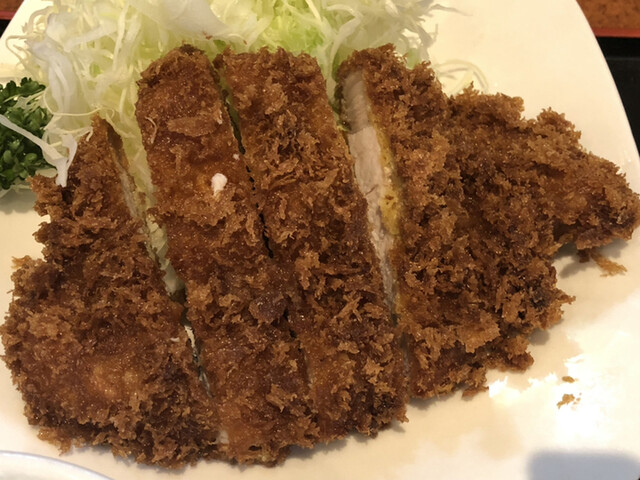
The tonkatsu is fried until it becomes a golden brown color. It belongs to the category of deep-fried foods, and the flavor of the batter is quite prominent.
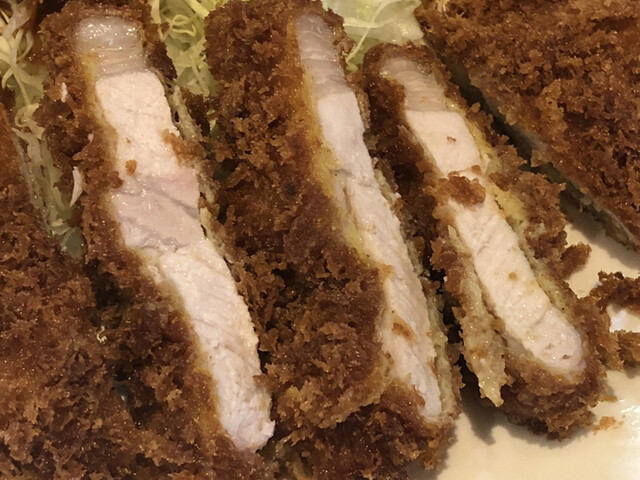
The thickness of the meat is about 1.2 cm at most, and it is cooked thoroughly inside.
The sticking of the fabric is not very good; when you try to pull it off with chopsticks, the fabric comes off quite easily.
The meat quality is not considered superior either. The fat portion is separable, and it's quite scarce. It doesn't reach the level where one can perceive a sweet taste in the fat.
Well, it seems that this isn’t a roes katsu, nor is it a kebab katsu… It’s just a typical “tonkatsu”.
After seeing the quality of this tonkatsu, I felt that it was the right choice not to order the regular menu items like Roshi or Teisei Roshi.
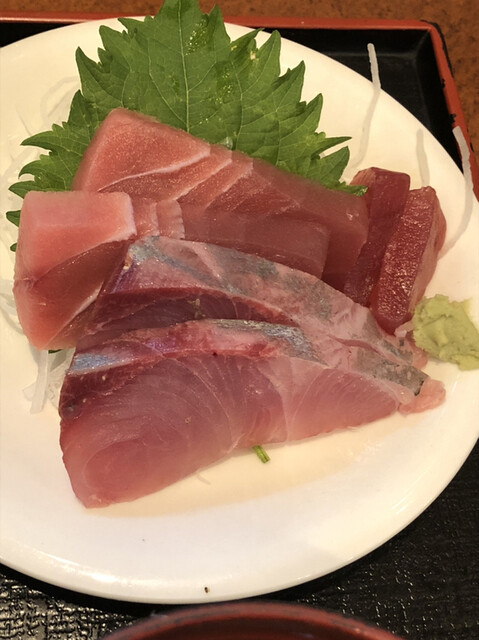
The sashimi consists of red meat from salmon and bream. However, even in the case of salmon, dripping can be observed, indicating that it is a frozen product.
Since it's a side dish for tonkatsu, I didn't expect too much. But the quality was just as expected.
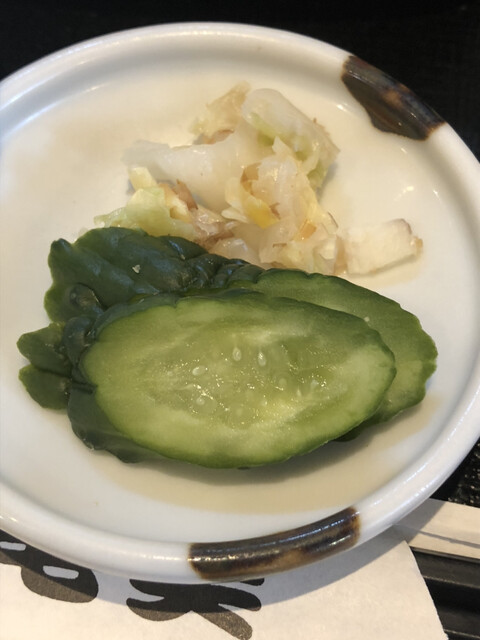
The dish that was delicious was the pickles.
This is a dish of cucumber and cabbage pickled in bran. The pickling process has gone quite deep, resulting in a strong and distinctive flavor.
The rice was cooked to an overly soft degree, and both the Uzu-maki Mugi and wakame-based miso soup were mediocre in quality, making them not worthy of praise.
The owner seemed to be in his mid-fifties, and it seemed that he was not yet old enough to be considered a "veteran" in the business. Therefore, it seemed appropriate to adopt a fresh and innovative management approach. However, the store still retained a strong sense of conservatism, resembling the image of an old-style tonkatsu restaurant from a bygone era.
Of course, it's true that there is a certain segment of customers who find it easier to interact with such restaurants, as they perceive them as being more accessible. Therefore, changing the core concept of a restaurant from the ground up requires courage.
In any case, it seems that the best approach is to establish a business model at the point where the trends of the times intersect with the needs of local residents. I hope you will continue to strive towards this goal in the future.