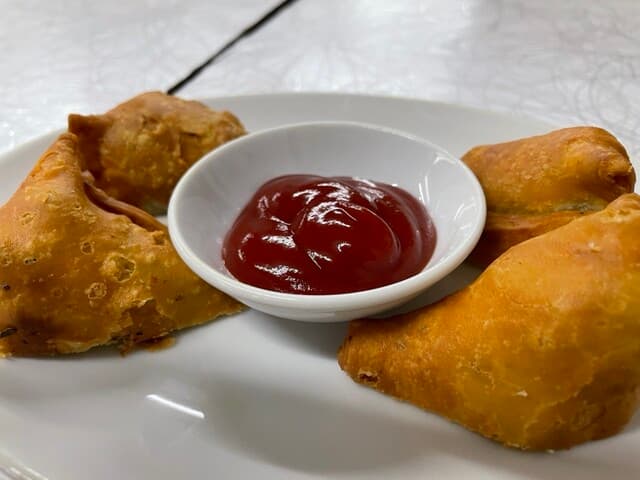
Looking back at the photos on my smartphone, I realized that the first time I ate Nepali cuisine, the dhalbhat, was in January 2020 (at a restaurant called Dantachoga in Kyoto). One month later, I tasted momo for the first time (again at Dantachoga in Kyoto). Another month later, I tried samosa and chowmyn for the first time (at Namaste Terzima Haru Matoyama in Kyoto). And then, I had those samosa and chowmyn at Gandara Inuyama.
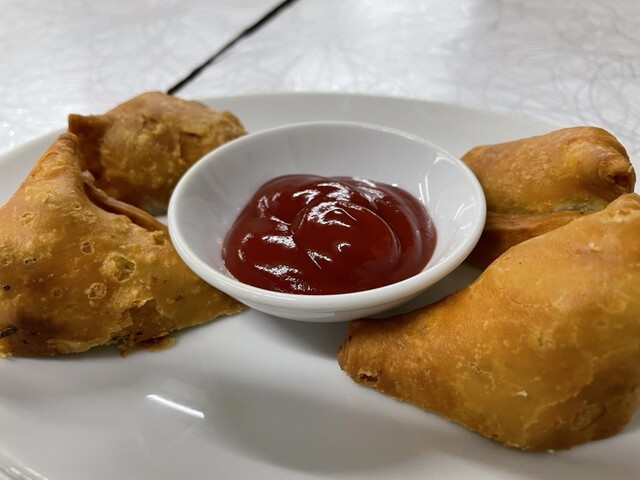
★サモサ
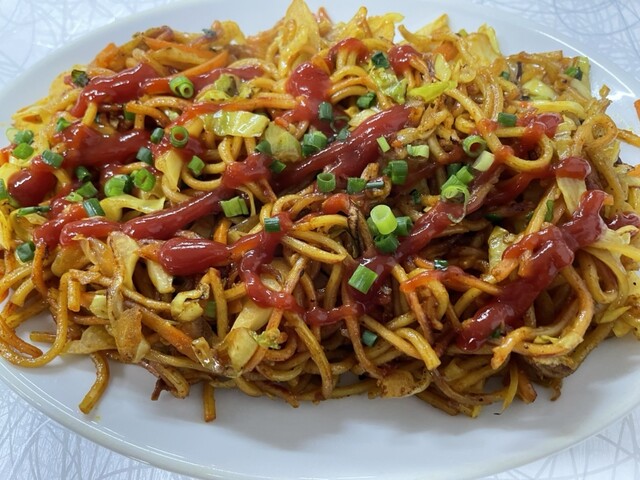
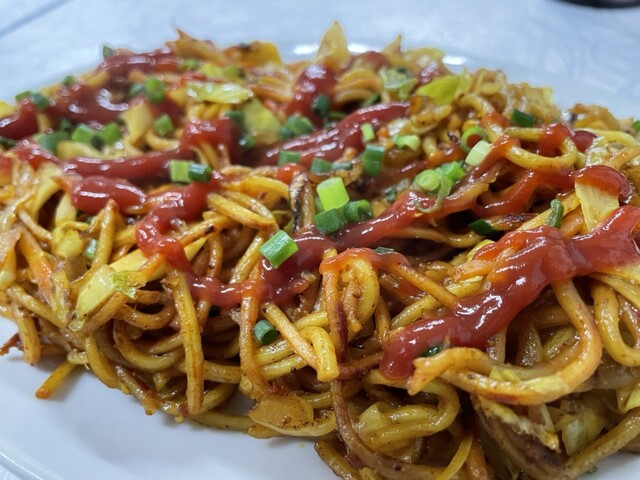
★チョウミン(野菜)
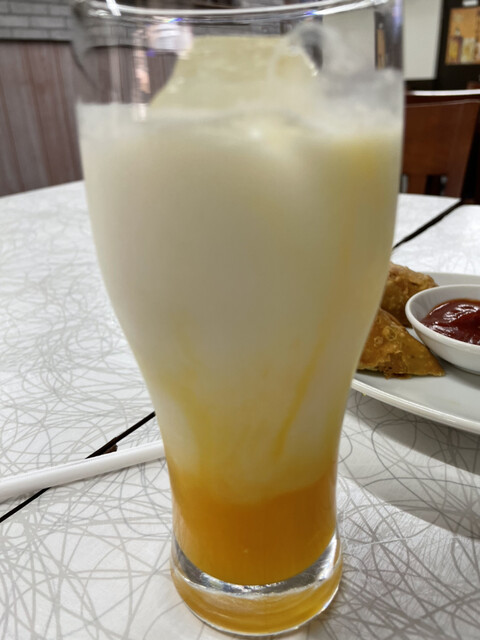
As a frequent customer discount was also available, and considering it was my last visit to Nepal before returning, they served me mango lassi for just 1000 yen.
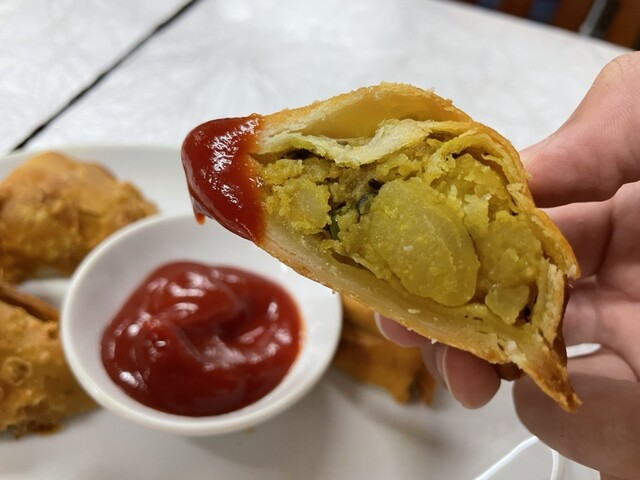
サモサは、インドネパール版のコロッケと言えるだろう。三角形のサモサが2つあり、それぞれ2等分されていて、ケチャップを囲んで横に置かれていた。私はサモサに優しく声をかけた。「ねぇ、こっちを向いてよ、サモサ」顔を上げてくれない。仕方なく、尖った部分をつまんでケチャップをつけ、断面をこちらに向かせた。back numberが『高嶺のサモサさん』で歌っているように、「でも~見た~い、隣~で目覚~めて~、おはようと笑う」と想像してしまった。
The dough of samosa is thicker than that of corncakes, and it has a crispy texture similar to that of cookies. Inside, there are potatoes and beans seasoned with spices. The flavor of cumin seeds is strong, giving a spicy taste. There isn’t much greasiness; it can be eaten as a snack.
Choumin is a Nepali-style fried soba. What sets it apart from Japanese fried soba is the seasoning. The spices are quite strong, making the dish extremely spicy. There are plenty of vegetables included, such as cabbage and carrots. This restaurant’s Nepali single-course dishes are affordable and delicious. They truly deserve to be called "Nepali-style cuisine" in Dogan.
---------------------------------------------------
Today’s conversation with the Nepali brother centered around weddings. (I was scheduled to attend a friend’s wedding the next day.) In Nepal, when people get married, the groom usually gives the bride jewelry made of gold or diamonds. The bride, on the other hand, gives the groom a car or motorcycle as a gift. There’s also a tradition in Japan where money is given as a wedding gift. Apparently, in Nepal, the bride often has to bear a significant financial burden. Many Nepali couples choose to get married in Japan. The brother showed me that video on the TV inside the restaurant.
Innepa restaurant is interesting not only because of its cuisine, but also because it offers valuable insights into various aspects of different cultures. Innepa represents the essence of all aspects of a diverse culture.
Dunnebird. Thank you for your hospitality.
During my student days, when I was reading books on language acquisition, the author, who was a researcher, explained various academic theories in a serious manner. In the end, he concluded that "the best way to acquire a language is to find someone to speak that language with." I was utterly baffled by this conclusion. But perhaps it's true. It's important to enjoy learning and maintain motivation. Whether one can continue doing so is the key. And this is something that aligns with the essence of Innepa's approach.
-------------------------------------------------
Preserve paragraph breaks, inline line breaks, HTML tags, HTML entities, numbers, prices, URLs, placeholders, and punctuation.
Translate all narrative text into the target language. Keep proper nouns only when needed.
Output must be natural English.
Avoid leaving Japanese script in descriptive text; translate or romanize only unavoidable proper nouns.
Do not mix Latin letters with Japanese characters inside the same word.
This is segment 13/111. Translate only this segment and keep the wording natural.
As soon as I opened the door of Gandhara’s restaurant in Kanayama, the usual Nepali waiter at the restaurant started talking with great enthusiasm, as if he had just turned on the switch to speak. Since my first visit, when I tried to engage him in conversation in Nepali (since early 2020, when I began focusing on Nepali cuisine restaurants, I have been intermittently learning Nepali), he has been speaking Nepali with a relentless enthusiasm. I think this is about the level of the “i+1” hypothesis proposed by S. Krashen. I try to listen attentively, as if I were trying to catch a powerful volleyball serve. That speed helps me to concentrate.
It seems to be something along these lines. “I was just talking about you yesterday. There was a Japanese customer who visited Nepal several times. So, I said, ‘I know someone who plans to go to Nepal next month or the following month.’” I replied, “Where exactly in Nepal did that person go?” As we kept repeating this process, 10 minutes passed. Before forgetting it, I ordered two Nepali dishes.
★チキンチリ 660円
★ジラライス 330円
I would describe this dish as chicken chili, which is essentially pork used in pickled dishes replaced with chicken, seasoned with spices. It's a bright red color, embodying passion. "Chicken Chili of Passion." Just like Blue Hearts might sing, "Let the passionate, bright red chicken chili bloom in our hearts." The chicken seems to be finely chopped. Vegetables such as onions and peppers are used in this dish. They are mixed with tomato-based sauce, creating a refreshing yet spicy flavor.
I ate Jira Rice with Chicken Chili as a side dish. “Jira” is a Nepali word for turmeric. Turmeric is a type of spice, and Jira Rice is simply rice that has been stir-fried with turmeric seeds. The rice has a slightly brownish color, and it exudes the distinctive aroma of turmeric. The rice used in this restaurant is a mix of Japanese rice and Basmati rice. It’s cooked to a slightly firm texture. This makes the combination of rice and turmeric more appealing.
I was served mango lassi. I inserted a straw into the slender glass of premium wine. On the TV in the restaurant, a film titled “RELAXATION FILM” was playing, showing beautiful landscapes of Nepal. While watching that, I tilted the glass, and somehow, the mango lassi spilled onto my pants. “Mango lassi... I spilled it...?” I couldn’t say the word “spilled” because it didn’t appear in my vocabulary. I asked, “What should I call something that has been spilled?” The waiter explained that it’s called “pokyo”. Words learned in real life tend to be more easily remembered. This is a case of experiential learning, inspired by J. Dewey’s philosophy.
-------------------------------------------------
Preserve paragraph breaks, inline line breaks, HTML tags, HTML entities, numbers, prices, URLs, placeholders, and punctuation.
Translate all narrative text into the target language. Keep proper nouns only when needed.
Output must be natural English.
Avoid leaving Japanese script in descriptive text; translate or romanize only unavoidable proper nouns.
Do not mix Latin letters with Japanese characters inside the same word.
This is segment 21/111. Translate only this segment and keep the wording natural.
I only spoke in Nepali. “Did you hear about the plane crash in Nepal a while ago?” I asked. “It crashed again yesterday,” said the brother. “Some people say there’s nothing in Nepal at all,” I said. Then he replied, “Nepal has many things.” So I said, “Maybe there’s something in Nepal that really means ‘nothing’.” We spent one and a half hours together, allowing my language brain to fully develop.
1時間半で990円。自然に笑い飛ばしながら楽しめるワンレッスンが990円。美味しい料理まで付いてきます。こんなコスパの良い外国語レッスンって他にありますか?どの英会話スクールや言語アカデミーも、これほどお得なプランを提供していません。だから私はネパールに来るのです。ネパール人の彼女を作るよりも、ずっと手軽ですよ。
When I look at myself from a broader perspective, the Innepa and Nepali restaurants that I visit repeatedly seem to be places where the staff are kind and friendly. In other words, they are locations that make it easier for me to utilize them for my Nepali language learning. When I leave these restaurants, dopamine flows in my brain like a waterfall, reigniting my motivation to learn. With the support and strength gained from these Innepa and Nepali restaurants, I decided to put EatLog on standby at the end of October and embark on a long journey to Nepal.
Dunnebord. Thank you very much for your hospitality.
It was just as the rainy season had begun. On Sunday, there was light rain in Gionayama. I walked along the street that stretched westward from Gionayama Station, wearing an umbrella. After noon, I visited Gandara Gionayama Restaurant. The fact that Nepali cuisine is affordable, and that the Nepali staff at the restaurant are very kind, these aspects of the restaurant’s charm made me decide to visit there regularly.
The interior of the restaurant was somewhat quiet. Due to the rain, there were no other customers present. The young man who usually worked at the store was glued to the screen on the high shelf, watching a cricket match between Australia and Afghanistan.
I turned my gaze downward and opened the menu. Ah yes, the Nepali cuisine items had increased in price by about 10%. Still, they remain affordable prices. I ordered two items at a time. I was given a salad as a service.
--------------------------------------------------
★パニプリ 440円
It is a street food from Nepal. "Pani" refers to the brown soup in the center, while "Pri" refers to the spherical objects around it, resembling ping-pong balls.
The pretzel contains potatoes and crushed chicken (instant noodles). I pour pan sauce over it and eat it in one bite. When I bite into the pretzel, a cold soup with a strong salt and sour taste spreads in my mouth. There must also be chili peppers in there. A stinging sensation remains on my lips.
The Nepali cuisine in this restaurant is made using natural and simple ingredients, and the panipuri is no exception. It allows you to experience the flavors of everyday Nepali life. When watching a cricket match, be careful not to throw away the panipuri—it’s quite tempting!
★チョイラセット 770円
A large silver plate, as if meticulously polished, reflects the brightness of the interior. On top of it are layers of rice hase, along with fresh vegetables, chutney (orange-colored spice sauce), and chola.
チョイラには玉ねぎや香辛料が加えられ、鶏肉も一緒に和えて提供されています。ニンニクや生姜もたっぷり入っています。鶏肉は柔らかくてジューシーで、量も予想以上に多いです。白米の上に乗せると、成長中の子供が喜ぶことでしょう。
As side dishes, I eat Choli and Achchar. For 770 yen for this set, I think it’s a reasonable price compared to other restaurants.
--------------------------------------------------
While eating, I tried to ask a question that a cricket fan might be angry about: “Why do they throw the ball in such a strange way?” The older brother and the boy explained the rules of cricket to us. The three of us watched the match with bated breath. It seemed like a typical Japanese Sunday afternoon—lying on the sofa and watching baseball. Is this also a common activity in Nepal? How do people in Nepal spend their weekends during the rainy season?
I felt more like I was visiting a relative’s house rather than a restaurant. It’s a very down-to-earth, intimate place indeed. The match ended with Afghanistan winning.
Danebord. Thank you very much for your hospitality.
Due to cycling for 3 hours the previous day, my thighs were sore from muscle pain. However, I really wanted to try Nepali cuisine. Considering that it was a place not too far from my daily routine, I decided to have lunch at "Gandara Inuyama Branch", which is located about 10 minutes walk from Inuyama Station towards the west.
“ナマステ~”と両手を合わせて、いつものネパール人のお兄さんに挨拶をした。チベット系ネパール人の祈祷旗「タルチョ」が、視界の上の方で鮮やかな色を放っていた。店員さんが新しく一人加わっていらっしゃった。これで4回目の訪問だが、店の中は徐々に変化を遂げているようである。
-------------------------------------------------------
One of the reasons I liked this restaurant is that Nepali cuisine is affordable.
★野菜をメインとした料理 550円
★モモ 500円
Choumin is a Nepali-style fried soba. As the name suggests, it indeed delivers the expected Choumin experience. The difference between this dish and Japanese fried soba lies in the addition of ketchup on top, as well as the use of spices. I ordered it at medium heat, and I ate it with chopsticks. It made my body feel warm. The dish contains crisp vegetables such as cabbage and onions, making it very delicious.
This segment is from the 49th of 111. Translate only this segment and keep the wording natural.
**Translation:**
The momo here is known as Nepali-style steamed dumplings. This is my third time enjoying the momo at this restaurant. The small-sized momo has a firm outer skin and a juicy chicken filling inside. Even when dropped onto a plate, it seems like it will bounce up to the ceiling like a superball. I can simply pick up the tomato-based chutney placed in the center of the plate and stuff it into my mouth.
Both dishes are considered to be honest and unpretentious meals. They have a homey flavor that should be easily accepted by both Japanese and Nepalese tastes. Most importantly, the prices are very reasonable. The waiter also provided me with a salad and mango lassi as a bonus.
-------------------------------------------------------
In the table behind me, there were three boys who appeared to be elementary school students. I have never seen such a scene outside of a food court before. The older brother said to them, "If you want to eat butter chicken curry, then it's okay to pay the price of the daily curry menu." How kind-hearted he is, that brother.
There were also customers who were from Nepal. I chatted with him and my brother. I learned about the medical and economic conditions in Nepal. It started to rain, so I grabbed an umbrella and checked the time. It seemed like I had been there for two hours today. The muscle pain was completely gone. My brother offered a discount of 1000 yen on the item I purchased.
The staff are very kind-hearted, and the food is excellent. It has a charm that could be described as a typical town-style Chinese restaurant in the Innepa region. It seems like a place that is suitable for people of all ages, from children to adults, and locals to visit easily. Of course, even if outsiders come to the town while strolling around, and notice the signboard of the restaurant, they will definitely be welcomed warmly.
Dunnebird. Thank you for the hospitality.
It was a clear day with no clouds in the sky, creating a pleasant atmosphere that suggested spring was approaching. We walked for about 10 minutes along Koyama Street, which stretches westward from Koyama Station, until we reached the entrance of the castle town. There were two Nepalese male staff members at the "Gandaara Koyama Store". As soon as we entered, we shook hands and greeted them, then took our seats.
This is the third time I've visited this restaurant. Although it claims to serve Indian cuisine, like the previous visits, I ordered Nepali dishes. While waiting for my food, the staff asked me, "How would you like to have some naan?" They went around each table to inquire about individual preferences.
----------------------------------------------------
★サモサチャット 600円
“A dish that is topped with chickpeas, spices, and yogurt.” Samosa can be considered an Indian-Pakistani version of a croquette. It is cut into smaller pieces and mixed together to create a unique dish. Every time I try Samosa Chat, I find it to be a fascinating way of eating. The person who first developed this dish is truly a genius.
This restaurant’s samosas were characterized by their slightly soup-like consistency. Overall, it had a curry-like flavor, with the addition of various ingredients such as yogurt, ketchup, onions, beans, snacks, potatoes, samosa skins, and more. The dish was a harmonious blend of flavors—there was a spiciness, a sourness, a crisp texture, and a crunchy feel. It was delicious.
★スープモモ 600円
“Steamed Nepali-style dumplings in soup” is how the menu describes this dish. When it comes to Nepali cuisine, mango is an essential ingredient.
スープモモは通常、深い器に入って運ばれてくることが多いですが、この店では平らな皿に入ってきます。そのため、8個のモモがまるで湯船の中にあるかのように見えました。私は「可愛いですね」と率直な感想を述べました。
The soup has an orange color with a transparency reminiscent of the sunset. Its taste is simple and unremarkable. The mango is both the skin and the filling are soft and elastic. Although it’s small in size, it’s rich in garlic flavor, making it easy to pour into your mouth like a ball of sweetener.
----------------------------------------------------
Indeed, the Nepali cuisine here is simple and natural in its taste. It seems to be easily accepted by both Japanese and Nepali people. The set of naan and curry is also available at a reasonable price, making it convenient for our wallets.
At 12 o’clock, no customers came, so I had a pleasant conversation with the Nepalese waiter. The smile that came from within his body seemed to convey a sense of acceptance towards me. He even served me mango lassi as a treat.
These kind of populist restaurants are my favorite. I really want to visit them again and again.
Dunnebird. Thank you very much for your hospitality.
It was a sunny day that felt like spring. So, I really wanted to go outside. I rode my bicycle for an hour towards Dogan Station, and then continued riding westward along a gentle slope. Opposite the entrance to Dogan Castle Town, there’s a store called “Gandaara Dogan Branch”. If we were to name it after the title of the anime “Conan”, it could be called “Innepa of Ienuma Street in Dogan Town”.
I parked my bicycle and entered the restaurant. A Nepali man greeted me, just as he did last time. He was tall, wearing a Nepali hat called "dakhtopi" in bright colors. Look at him—he looked really cool.
-------------------------------------------------------------
★ネパールセット 850円
This time, I decided to try Dalbat (a Nepalese meal). The spiciness was medium, and I chose Lassi as my drink. We were served a salad with shredded cabbage, topped with a yellow, sour dressing.
Looking at the Dalbart that had come here, the first word that came to my mind was “theme park”. I don’t know exactly why I thought that. Perhaps it was because it reminded me of Dogan’s Little World. It definitely resembled a theme park in appearance. Especially from the side angle, the mound of rice looked like a dome, and the round little patpad (bean snacks) resembled some ethnic decorations in a house. Next to them were dishes like tarkali (stir-fried vegetables), sorg (stir-fried greens), and some raw vegetables. On the other side, there was a pond of dal (bean curry), chicken curry, and a waterfront with chachapuri (pickled vegetables).
In a theme park where one day isn’t enough to satisfy hunger, we eat here in just 10 or 20 minutes. The Dal is made using mixed beans, and it had a strong consistency. The large amount of garlic added gave it a delicious aroma that stimulates appetite. The Chicken Curry had a consistency and flavor reminiscent of tomatoes being crushed tightly. It was spicy, and the chicken was also tender. The fact that both the Dal and the Chicken Curry were served in small portions made it seem incredibly cute.
As for the side dishes, there were two slices of raw vegetables each, namely cucumber and carrot. Additionally, there was stir-fried cabbage served alongside them. The acharal was the same as last time; it seemed to be simply boiled tomatoes with a light sprinkle of spices. It provided a refreshing taste.
The rice was a mix of Japanese rice and basmati rice, which was quite convenient. The brother explained that basmati rice is more expensive, and Japanese rice provides a greater sense of fullness. In any case, at 850 yen for this amount of food, it seems that both the mind and the stomach are fully satisfied.
-------------------------------------------------------------
After eating, I drank a very small amount of lassi. My brother mentioned that the day after tomorrow is Valentine's Day. So I asked, "Is there any tradition in Nepal of giving chocolate?" He replied that there was such a tradition. Meanwhile, several other customers came, so he had to take care of them.
I really wanted to talk more with my brother, so I ended up staying there for two hours. It might be rare to find a theme park where you can enjoy yourself for 2 hours at 850 yen. The kindness of my brother makes me appreciate this place. And the natural smile on his face when he welcomes customers shows that it's something that anyone can imitate.
-------------------------------------------------------------
“もう帰る時間です。1時間かけて”と言いながら、私は会計を済ませて店を出た。決して広くはない犬山ストリートの端には、人々が行き交っていた。近くでは車も行き来していた。ネパールの首都カトマンズの繁華街、タメルの喧騒が思い浮かんだ。いや、タメルよりはずっと整備されている。
When I turned south from Koyama Street, I suddenly realized, “Ah, no! How could I have forgotten that moment? I managed to retrieve the foreshadowing from my last visit. That’s what I should have said in response to the topic of Valentine’s Day.”
I am looking forward to seeing Nepali girls giving me Panipuri.
Dunnebird. Thank you for your hospitality.
It was raining, and the streets of Gionyama Castle Town were sparsely populated at dusk. Around 7 p.m., I headed towards the "Indian Restaurant Gandara" located nearby. Originally, it was an Indian-Nepalese restaurant called "Sunrise". However, the management must have changed, as this is common in the hospitality industry.
I glanced at the Nepali customers who sat at the tables on the left side as I entered the restaurant. Then, greeted by the Nepali staff who were visible from the kitchen, I sat down at a table in the far corner of the room.
The chef brought me some water. He wore a Nepali hat with a bright-colored design called "dakhatopi". His natural smile was very pleasant, and it gave me a sense of comfort.
---------------------------------------------------------------------
This is an Indian restaurant, but the menu includes a section dedicated to Nepali cuisine. All the dishes are affordable. After ordering two items, I added one more item as a supplement.
Inside the restaurant, a match of volleyball from Nepal was being broadcast on the TV. The young man working at the store explained that volleyball is a sport in Nepal. Oh, I didn’t know that. While I was thinking about all this, suddenly, the Bautan set appeared on the screen.
---------------------------------------------------------------------
★ブタンセット 700円
On the menu, it is labeled as “Sheep Intestines Stir-fried with Spices”. Other customers from Nepal told me that “Butan” comes from the Nepali word “Bhotunu”, which means “stir-fry”.
It is stir-fried with onions and spices, and there is no unpleasant odor typical of internal organs. The vegetables are finely chopped, making them easy to eat. They have a pleasant elasticity and taste delicious. Along with tomato chutney, cabbage, carrots, and cucumber chutneys, we also ate rice hase along with some more food.
---------------------------------------------------------------------
★ モモ 500円
Nepalese-style steamed dumplings with mango. Eight small dumplings are arranged in a circle on the plate, with tomato chutney placed in the center, just as before.
I put the momo on the achchar and ate it in one bite. Both the outer skin and the chicken filling inside are light and elastic. Achchar seems to be something like tomatoes simply boiled together, with a little spice added. It really livenes up the taste. It feels like I can eat as much as I want.
---------------------------------------------------------------------
★パニプリ 400円
Nepal’s street food stall “Panipri”. It consists of thin ball-shaped dough filled with potatoes seasoned with chili peppers, as well as Chau Chau (Nepal instant noodles). A soup is poured into the center, and it is eaten in one bite.
Along with a crisp texture, a sour soup spreads throughout the mouth. The chili is quite strong and quite spicy.
The valuable information I obtained is that Nepali women tend to prefer Panipuri. If you approach a Nepali woman who shows goodwill, you might just prepare Panipuri and fill it with soup. Then, simply say "Cheers!" and toast together.
---------------------------------------------------------------------
While it doesn’t have a strong impact on the palate, I felt that it was a straightforward, unpretentious Nepali dish that was easy to eat. It had a natural flavor, and I thought it would be suitable for both Japanese and Nepali tastes.
There is a Japanese school nearby, and it seems that Nepali students visit during lunchtime. That's why the prices of Nepali dishes are relatively low. They are offering the flavors of their homeland at an affordable price to the students.
For Japanese people who enjoy Nepali cuisine, this place is quite attractive. The staff were also very kind, so I decided to visit again to try the Dalbhat dishes.
Danebord. Thank you very much for your hospitality.